This project has been created as part of the 42 curriculum by aamhamdi.
push_swap
Description
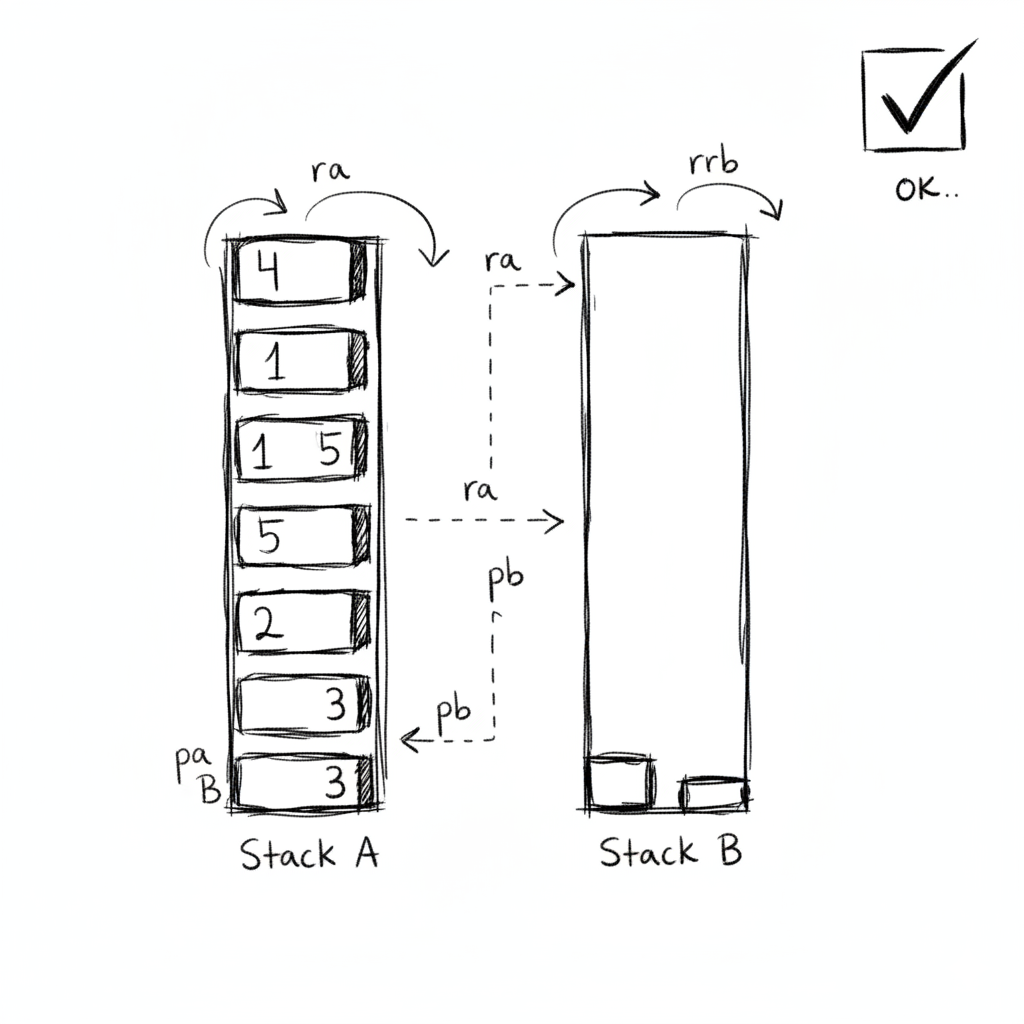
push_swap sorts a stack of unique integers using only two stacks (a and b) and a small, fixed set of operations (sa, sb, ss, pa, pb, ra, rb, rr, rra, rrb, rrr), aiming to do it in as few operations as possible. The program takes the unsorted values as its arguments, computes a sequence of operations that sorts a in ascending order (smallest value on top), and prints that sequence to standard output — one instruction per line.
A companion bonus program, checker, reads a sequence of operations from standard input and replays them against a given stack, reporting whether the result is actually sorted (OK) or not (KO).
Algorithm
- ≤ 3 elements: solved directly with at most two operations (
sort_three). - ≤ 5 elements: the two "extra" elements above 3 are temporarily pushed to stack
b, the remaining 3 are sorted withsort_three, then everything is pushed back ontoaat the right position (sort_five). - > 5 elements (
sort_algo): every node inais ranked by its sorted position, then nodes are pushed ontobone at a time — at each step, the node that's currently cheapest to relocate (combining the rotate/reverse-rotate distance on bothaandb, picking whichever direction is shorter) is moved first. Onceais reduced to 3 elements, those are sorted directly, and the rest are pushed back frombontoain sorted order, each one going to its optimal position. This cost-based approach is what keeps the operation count well under the benchmark limits for large stacks (see below).
Internally, both stacks are implemented as a doubly linked, circular list (t_list/t_stack), which makes rotations cheap and avoids reallocating/shifting an array on every push.
Measured performance
Run with several batches of random unique integers in [-100000, 100000) and verified against the project's own checker:
| Stack size | Operations (typical) | 100% validation threshold |
|---|---|---|
| 100 | ~540 – 620 | < 700 |
| 500 | ~5050 – 5350 | < 5500 |
All runs sorted correctly (checker reported OK), and both sizes land comfortably within the subject's top validation bracket. Exact counts vary slightly between runs since the input is randomized.
Instructions
Compilation
make          # builds push_swap
make bonus    # builds checker (links libft + a local get_next_line)
make clean    # removes object files
make fclean   # removes object files and both binaries
make re       # fclean + all
The Makefile builds libft (vendored in libft/) via its own Makefile first, then links it into both push_swap and checker. Compiled with -Wall -Wextra -Werror via cc.
Running push_swap
./push_swap 2 1 3 6 5 8
sa
pb
pb
pb
sa
pa
pa
pa
Arguments can be passed either as separate shell arguments or as a single quoted, space-separated string — both are accepted. With no arguments, the program prints nothing and exits. Invalid input (non-integers, out-of-range values, duplicates) prints Error on stderr.
./push_swap 0 one 2 3
# Error
Running checker (bonus)
ARG="4 67 3 87 23"
./push_swap $ARG | ./checker $ARG
# OK
checker takes the same initial stack as push_swap, then reads a sequence of operations (one per line) from stdin, applies them, and reports OK if a ends up sorted, KO otherwise, or Error on invalid input/instructions.
Resources
- push_swap visualizer (community tool) — useful for watching the stacks move step by step.
- General algorithmic background: insertion sort and "radix sort on stacks" approaches, which are the two classic strategies discussed for this project (this implementation follows a cost-based/greedy variant rather than literal radix sort).
man qsort,man malloc— standard C reference material used while implementing the linked-list stack structure.- 42's own Norm documentation, for the coding-style constraints the project must follow.